SIXTY VOTES FOR EVERYTHING, WRITTEN DOWN NOWHERE
The most powerful veto in American government is not in the Constitution, was created by accident, and can be abolished this afternoon by fifty-one senators.
0Mentions of the filibuster in the Constitution. The Framers rejected supermajorities for ordinary bills on purpose.
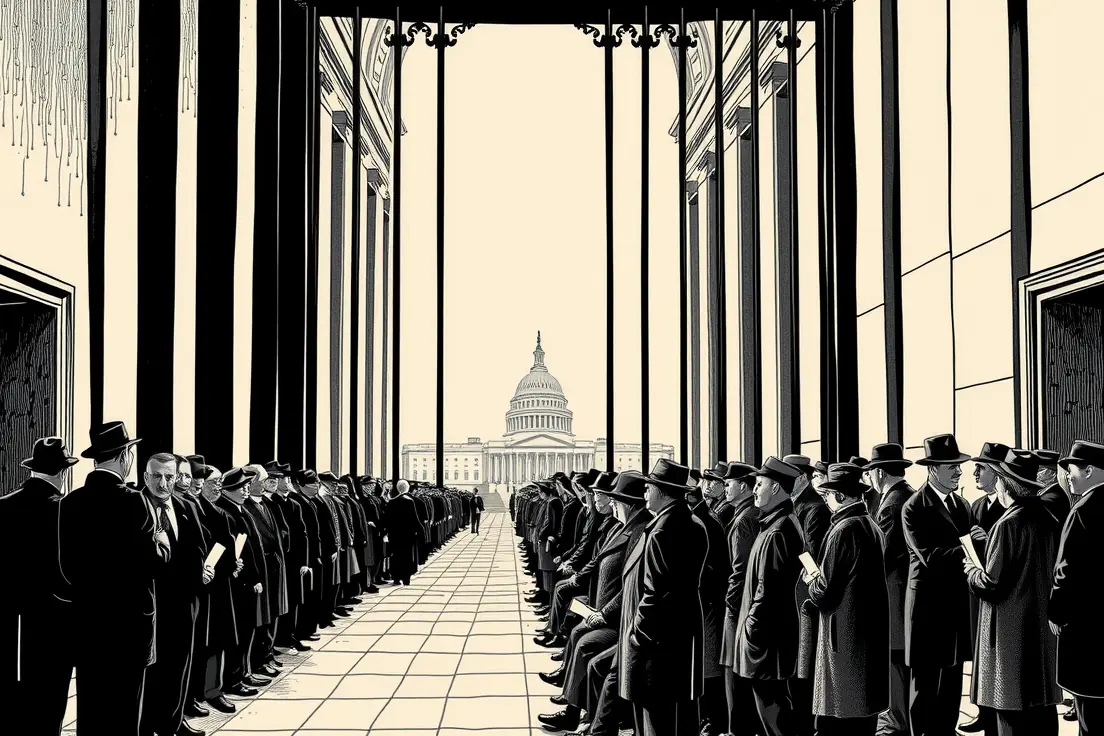
It began as a housekeeping error in 1806 — a redundant rule deleted, leaving no way to end debate.
FACT: The filibuster is not in the Constitution. It is not in any statute. It was not designed, debated or adopted — it is a side effect.
An accident nobody noticed for thirty years
In 1806, on Aaron Burr’s advice, the Senate stopped using the “previous question” motion as redundant. That motion was the mechanism for ending debate. Nobody noticed the implication for decades, because senators did not routinely refuse to stop talking. The first true filibuster came in the 1830s. Cloture — a way to force a vote — was not created until 1917, and required two-thirds; it was lowered to three-fifths, or 60 votes, in 1975.
The Framers considered supermajorities for ordinary legislation and rejected them explicitly. The Constitution names the handful of cases requiring more than a majority — treaties, impeachment conviction, expulsion, veto override, amendments — and the list is short and deliberate. Hamilton warned in Federalist 22 that a supermajority requirement means “the sense of the smaller number will overrule that of the greater,” producing “tedious delays; continual negotiation and intrigue; contemptible compromises of the public good.”
It began as a housekeeping error in 1806 — a redundant rule deleted, leaving no way to end debate.
Two changes turned a weapon into a wall
First, the silent filibuster. Since the 1970s a senator need not hold the floor, speak, or even be present. A phone call signalling objection is enough, and the burden flips onto the majority to find sixty votes. The image of a lone senator talking through the night is a museum piece; the modern filibuster is an email.
Second, volume. Cloture motions numbered a handful per decade in the mid-twentieth century. They now run to hundreds per Congress. What was an emergency brake became the default speed.
Notice what is already exempt
The most revealing thing about the filibuster is the list of things senators have already decided it should not apply to. Reconciliation cannot be filibustered; the Senate went to a simple majority for executive-branch and lower-court nominations in 2013, and extended it to the Supreme Court in 2017.
| Business | Threshold | Exempted when |
|---|---|---|
| Budget reconciliation | 51 | 1974, expanded since |
| Executive-branch nominations | 51 | 2013 |
| Circuit and district judges | 51 | 2013 |
| Supreme Court nominations | 51 | 2017 |
| Ordinary legislation | 60 | never |
Both parties took a turn dismantling it for the things they urgently wanted. Neither has touched it for laws. The filibuster does not protect deliberation in general — it protects the specific outcome of no legislation, and the Senate has repeatedly demonstrated it can remove the protection in an afternoon when sufficiently motivated.
What it actually does to the rest of the system
This is where the filibuster stops being a Senate curiosity and becomes the hinge of nearly everything else on this site.
- The congressional stock-trading ban passed the House in July 2026 and will not get sixty votes in the Senate. It does not die of opposition; it dies of arithmetic.
- Expanding the House requires only a bill and a signature — no amendment, no states. Sixty votes is why “only a bill” is not the low bar it sounds like.
- Dark-money disclosure, supported by roughly 80% of Americans, has been filed repeatedly and never cleared cloture.
- And when legislation becomes impossible, the demand does not evaporate. It migrates — to executive orders that reverse every four years and to a Supreme Court that now functions as the country’s working amendment mechanism.
The strongest case for it, taken seriously
The defence deserves better than caricature, so here it is at full strength. The Senate exists to slow things down. A bare majority in a single election should not be able to restructure the country, because majorities are temporary and mistakes are durable. Forcing sixty votes pushes legislation toward the centre, protects the minority from having its interests simply erased, and means that what does pass has enough support to survive a change of government.
That argument would be persuasive if the record supported it. It does not. The filibuster does not produce moderate laws — it produces no laws, and the pressure reroutes to the two branches that can act alone. A senator who defends the filibuster as a bulwark against executive overreach has the causation exactly backwards: the filibuster is why the executive governs by decree. The minority protection is real, but what it protects is not a minority interest — it is the status quo, whatever the status quo happens to be, including one nobody would vote for today.
What would fix it, and who is stopping it
Unlike almost everything else on this site, this one needs no amendment, no ratification, no Supreme Court, and no cooperation from the other chamber. Fifty-one senators can change Rule XXII on any given afternoon, and both parties have proved it by doing exactly that for nominations.
It survives for one reason, and it is not principle. Each party expects to be in the minority again, and values the veto it will hold then more than the laws it could pass now. That is a hedge — a rational one for each individual senator, and collectively a decision that the country will be governed by executive order and judicial opinion rather than by statute.
OPINION: The honest description is not that the Senate is broken. It is that the Senate has quietly chosen not to be a legislature, and has kept the title. A chamber that cannot pass laws is not deliberating. It is abstaining, with a quorum.
A supermajority requirement that applies to everything is not a brake. It is an off switch, and both parties keep their hand near it.