FOUR AND A HALF BILLION DOLLARS, AND YOU MAY NOT ASK WHOSE
More than half the outside money in the last federal election came from groups legally entitled to keep their donors secret — a right invented by regulators, not voters.
$1.9BDark money in 2024 federal races — a record, and that is only the part that can be counted
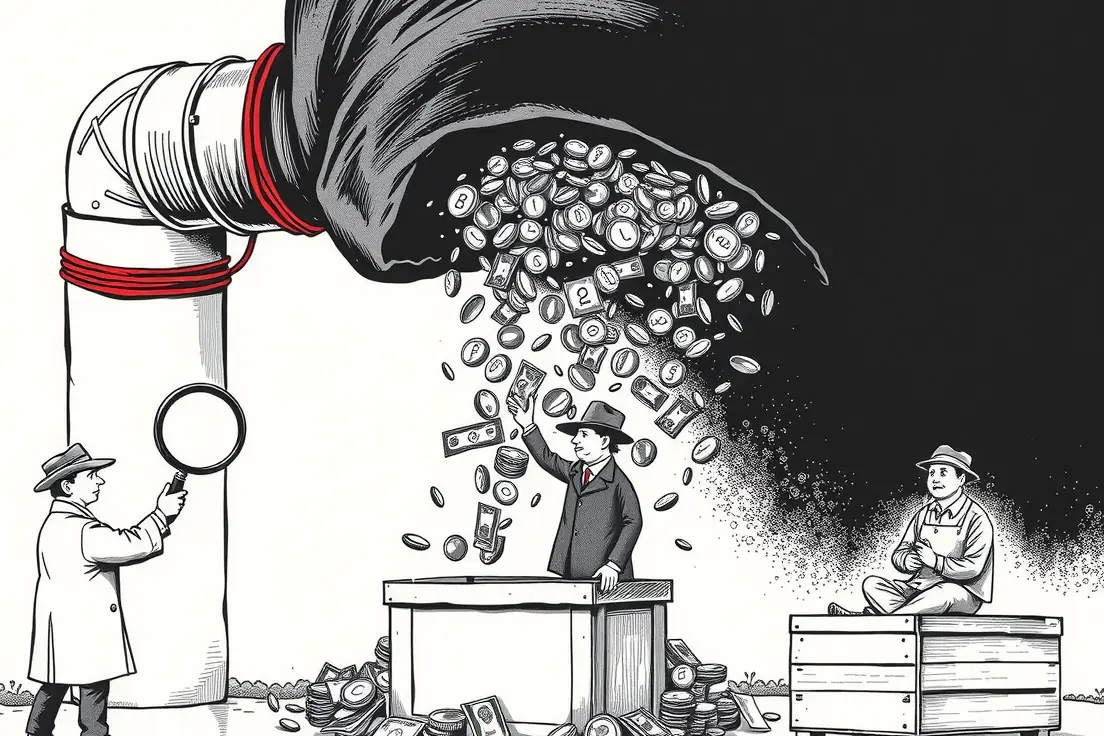
The Court that unleashed the spending assumed disclosure would police it. Disclosure did not arrive, and the ruling stayed.
FACT: Outside spending on the 2024 federal elections reached a record $4.5 billion, and more than half of it came from groups that do not fully disclose where their money came from. The Brennan Center puts the dark-money total at a record $1.9 billion — and that figure counts only what can be traced.
How the plumbing works
The plumbing is simple once you see it. A 501(c)(4) “social welfare” nonprofit may spend on politics so long as that is not its primary purpose, and it never has to name its donors. It then writes a cheque to a super PAC, which does disclose — and dutifully discloses that it received the money from the nonprofit. The disclosure requirement is satisfied. The information is gone. In 2024, shell companies and non-disclosing nonprofits gave $1.3 billion to super PACs this way — more than the previous two cycles combined.
Where it gets worse is the part nobody sees at all. Roughly 320 non-disclosing groups spent more than $281 million on online advertising during the cycle while reporting none of that spending to the Federal Election Commission — because online political advertising falls into gaps in rules written for broadcast.
The half of the bargain that never arrived
The Court that unleashed the spending assumed disclosure would police it. Disclosure did not arrive, and the ruling stayed.
This is the part that should annoy people across the spectrum, because it is a broken bargain rather than a policy disagreement. When the Supreme Court removed limits on independent political spending, the reasoning leaned explicitly on transparency: voters could evaluate the message if they knew who paid for it, and disclosure would do the work that limits used to. Eight of nine justices endorsed disclosure requirements in that very ruling.
The spending arrived immediately. The disclosure never did. Congress has not passed the disclosure legislation repeatedly introduced since. The FEC, designed with six commissioners and an even party split, deadlocks on enforcement by construction. So the half of the bargain that favoured spenders was self-executing, and the half that favoured voters required action from institutions that had every incentive not to act.
OPINION: You do not have to believe money is not speech to object to this. You can accept every word of the constitutional argument and still notice that the specific factual premise it rested on — that the public would know who was paying — turned out to be false, and that nobody has revisited the conclusion.
The numbers
| 2024 federal races | |
|---|---|
| Total outside spending | ~$4.5 billion (record) |
| Share from non-disclosing groups | more than half |
| Dark money, Brennan Center estimate | ~$1.9 billion (record) |
| Reached super PACs via shells and nonprofits | over $1 billion |
| Online ads by ~320 non-disclosing groups, unreported to the FEC | ~$281 million |
The strongest case against disclosure, taken seriously
There is a real civil-liberties argument here, and it has a distinguished pedigree: NAACP v. Alabama (1958) protected the membership lists of a group whose donors faced genuine danger. Compelled disclosure can chill lawful participation, and in an era of coordinated online harassment the fear is not hypothetical. Small donors to unpopular causes have a legitimate interest in not being doxxed.
The answer is that this argument protects individuals of modest means facing real threats — not eight-figure corporate spending routed through a shell to obscure a commercial interest in the outcome. A disclosure regime can be tiered by amount. What exists now is not a carefully drawn exemption; it is a hole large enough to drive a billion dollars through.
What would fix it, and who is stopping it
One statute closing the 501(c)(4) conduit and extending reporting to online advertising. No amendment required — this is about reporting, which eight of nine justices endorsed in the ruling that lifted the limits. It has never cleared cloture, and the agency that would enforce it is structurally deadlocked.
Roughly 80% of Americans, across both parties, support disclosure requirements. It is one of the least controversial positions in American politics. It has been for fifteen years. That it remains undone tells you precisely who the current arrangement is working for, and it is not the 80%.
Around 320 non-disclosing groups spent more than $281 million on online ads and reported none of it.