Best Congress Money Can Buy Votes To Stop Being Bought, Effective Later
The House just voted to restrict its own stock trading — while lobbying hit a record $4.4 billion, dark money nearly doubled, and 866 alumni sprinted to K Street.
$4.4BFederal lobbying in 2024 — an all-time record
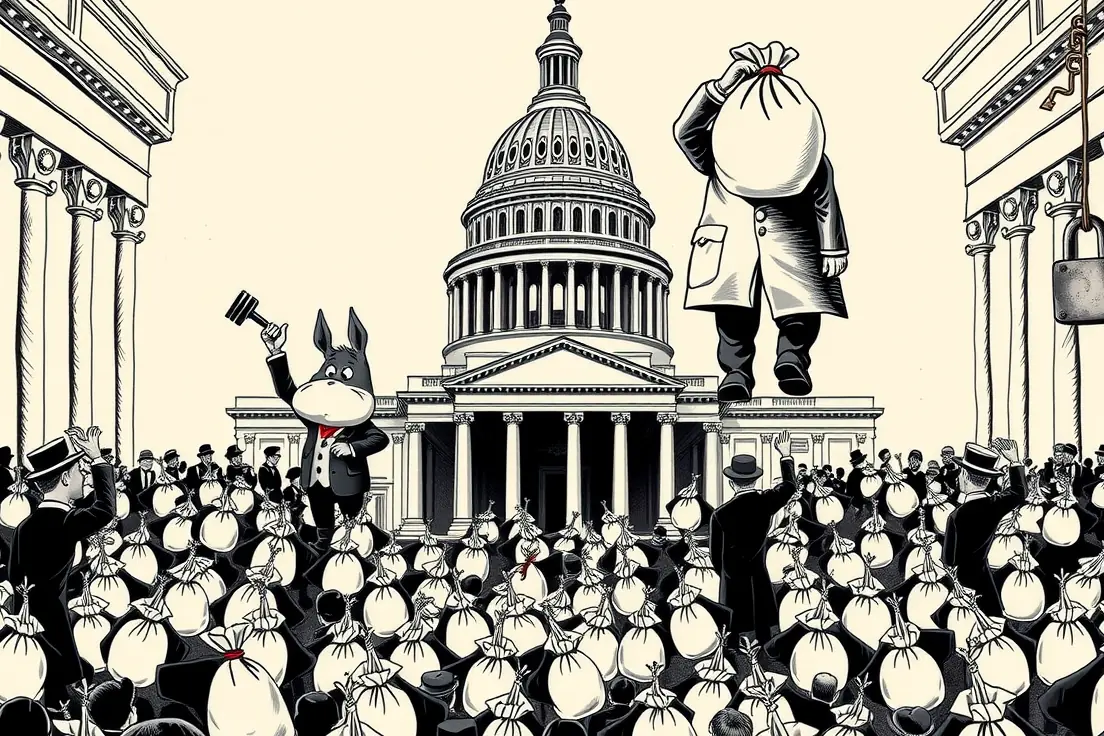
It is the legislative equivalent of a ‘Beware of Dog’ sign nailed to an empty doghouse.
On July 22, 2026, the House did something extraordinary: it voted 232–198 to stop members of Congress from trading individual stocks. Well, sort of. The Stop Insider Trading Act bars lawmakers from buying new stocks but lets them hold on to everything they already own (and sell it, with a week’s public notice), exempts the president himself, and — per NOTUS — is “likely dead on arrival in the Senate.” It is the legislative equivalent of a “Beware of Dog” sign nailed to an empty doghouse.
The revolving door changes what the job is
Consider the timing. Fourteen years after the STOCK Act passed in 2012, exactly zero members of Congress have ever been prosecuted under it (Christian Science Monitor), even though 86% of Americans across party lines want lawmakers barred from trading altogether. Congress heard the people, deliberated soberly, and produced a bill that mostly polices lawmakers who don’t exist yet.
Meanwhile, the actual market is booming. Federal lobbying hit an all-time record $4.4 billion in 2024 (OpenSecrets) — the health sector alone spent $743.9 million, a sum it insists is unrelated to your rising premiums. The 2024 election cost a record $15.9 billion (CNN), including $1.9 billion in dark money that nearly doubled the old record (Brennan Center). In a rare show of bipartisanship, that dark money fed both teams — roughly $1.2 billion for Democrats, $664 million for Republicans. Nobody ever said the trough was partisan.
Why ‘corruption’ is the wrong frame
The exit interviews are going great too. A record 866 members and staffers walked from Capitol Hill to K Street in 2025, up about 60% and past the 2007 record of 777 (LegiStorm); historically some 43% of departing members eligible to lobby go ahead and do it (Public Citizen). And why not? A House seat now runs about $3 million and a Senate seat about $30 million (OpenSecrets) — an investment best recouped across the street.
The revolving door is the part that deserves more attention than it gets, because it changes what a congressional career is. If the job paid $174,000 and ended there, the incentives would be one thing. If it pays $174,000 and functions as a paid apprenticeship for a lobbying position worth several times that, the incentives are entirely another — and the second description is the accurate one. The relevant audience for a member’s voting record is not only the district. It is the future employer watching from K Street.
This is also why “corruption” is the wrong frame, and why reformers who use it keep losing. Almost none of this is illegal. No envelope changes hands. What happens instead is that access is rationed by price, agendas are shaped by who is in the room, and the people in the room are the ones who can afford to be. A system can be entirely lawful and still produce outcomes indistinguishable from bribery — that is not an accusation, it is a description of the design.
The design has a tell, too. Notice which reforms attract genuine bipartisan enthusiasm and which quietly die: disclosure rules pass, spending limits do not. Rules that generate paperwork survive. Rules that reduce the flow do not. That is not gridlock — gridlock is random. This is a filter, and it points in one direction.
The strongest case against spending limits, taken seriously
The First Amendment objection is not a fig leaf and this site will not pretend otherwise. Money buys amplification, amplification is how speech reaches anyone, and a government empowered to cap political spending is a government empowered to decide how loudly its critics may complain. Incumbents write those rules, and incumbents have an obvious interest in limits that bite challengers hardest — challengers being the ones who must spend heavily to become known at all.
That argument is strong enough that the honest reform position is not limits first. It is disclosure — which raises no comparable speech problem, was the explicit premise the Court relied on when it lifted the limits, and has roughly 80% public support. Regulate the volume knob if you must; start by turning the lights on.
What would fix it, and who is stopping it
Disclosure legislation needs one statute. It has been filed repeatedly and never cleared the sixty-vote threshold. The FEC, built with six commissioners and an even partisan split, deadlocks on enforcement by construction — a design choice, not an accident. And the demand side would ease considerably if districts were competitive and seats cheaper to contest, because the cost of winning is what makes the money indispensable in the first place.
As for the buyers: Elon Musk alone spent more than $290 million in 2024 (CNN), one of six donors who each gave over $100 million — all backing Republicans (OpenSecrets) — while the 100 richest Americans covered about 7.5% of the whole election, one in every 13 dollars (Washington Post). The lone glimmer of hope: Sherrod Brown raised $100 million and lost anyway (OpenSecrets). Money can’t buy everything. Just most things.
In a rare show of bipartisanship, dark money fed both teams. Nobody ever said the trough was partisan.