THE HOUSE OF REPRESENTATIVES HAS BEEN FULL SINCE 1929
The Constitution says one representative per 30,000 people. A 1929 statute froze the number at 435 and nobody has touched it since — through a tripling of the population.
1 : 762,000Americans per House member today. The Constitution's floor was one per 30,000.
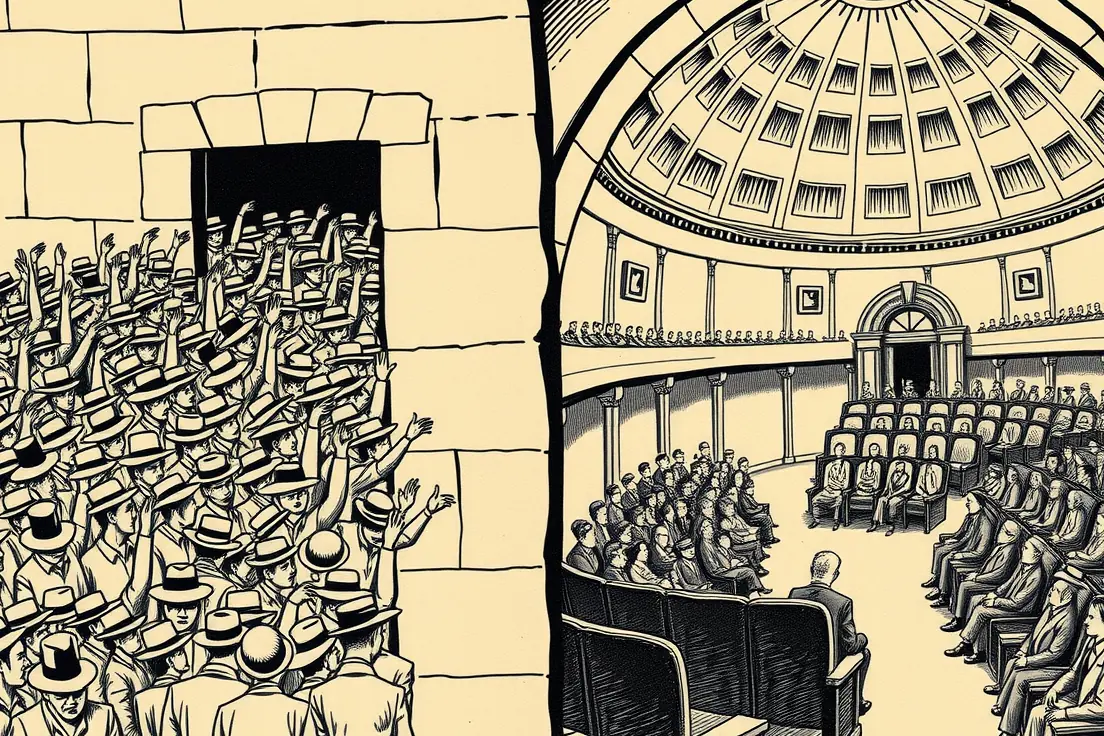
The number 435 appears nowhere in the Constitution. It appears in a 1929 statute, and a statute can be repealed by the body it constrains.
FACT: Ask most Americans where the number 435 comes from and they will tell you the Constitution. It does not appear there. What the Constitution says, in Article I, Section 2, is that the number of representatives “shall not exceed one for every thirty Thousand” — a ceiling on district size, not a cap on the chamber.
Where 435 actually comes from
The cap comes from the Permanent Apportionment Act of 1929, an ordinary statute passed in the year of the Wall Street Crash, after Congress had spent most of the 1920s unable to agree on reapportionment at all. It fixed the House at 435 and made the reapportionment formula automatic, so nobody would have to vote on it again. Nobody has.
The United States had roughly 122 million people then. It has around 335 million now. The chamber has not grown by a single seat. Each member now represents about 762,000 people — the least representative ratio in the developed democratic world, and roughly twenty-five times the Framers’ floor.
What the cap does downstream
The number 435 appears nowhere in the Constitution. It appears in a 1929 statute, and a statute can be repealed by the body it constrains.
The consequences are not abstract. Larger districts mean more expensive campaigns, which means more fundraising, which means more time with donors and less with constituents. They mean fewer competitive seats, because a bigger district is easier to draw safely. They distort the Electoral College, since each state’s electors equal its House seats plus two — so capping the House permanently inflates the weight of small states in presidential elections as well. And they make individual constituent contact close to meaningless: a letter to one office among 762,000 is not participation, it is a lottery ticket.
The standard fix is the cube-root rule — set the chamber at roughly the cube root of the population, which is how most democracies scale their legislatures and which would produce a House of about 690 members today, growing automatically with the country. The Brennan Center and a long list of scholars across the spectrum have made the case.
OPINION: Here is why this belongs on a site about incumbency rather than a civics blog. Every reform elsewhere on this site runs into a constitutional wall — term limits need an amendment, the Electoral College needs an amendment, campaign finance needs an amendment or a new Court. This one needs a bill. A simple majority in both chambers and a signature, and the House expands.
The strongest case for keeping 435, taken seriously
A larger chamber is a slower chamber. Debate time is finite, and 690 members means each one speaks less, committees grow unwieldy, and leadership gains power precisely because a bigger body is harder to coordinate — the opposite of the intended effect. There are practical objections too: the chamber physically seats 435, and doubling the payroll is a vote no member wants to explain.
The counterweight is that every legislature that has grown with its population manages, and the alternative is districts of three-quarters of a million people in which no representative can plausibly know their constituency. If a bigger House empowers leadership, that is an argument about internal rules, not about whether one person can represent 762,000.
What would fix it, and who is stopping it
This is the single most achievable reform on this site: a bill and a signature. No amendment, no state ratification, no Supreme Court. It also shrinks districts, which makes them cheaper to contest and harder to gerrymander safely, and it dilutes the small-state advantage in the Electoral College as a side effect. It has gone untouched for ninety-seven years under both parties because a smaller chamber makes every existing seat more valuable — and sixty votes means even “just a bill” is not a low bar.
It has not happened for ninety-seven years, through both parties’ majorities, because a smaller chamber makes each existing seat more valuable, each existing member more powerful, and each existing district safer. That is the entire explanation. There is no principled defence of 435 — it is not a magic number, it was not chosen for any theory of representation, and the people who could change it tomorrow are the precise people it benefits.
One representative per 762,000 people is the worst ratio in the democratic world, and it was set the year of the Wall Street Crash.