Congress Sets New Record for Doing Nothing, Immediately Adjourns to Celebrate
The 118th passed the fewest laws since the Civil War, the 119th ran the longest shutdown in history, and the $174,000-a-year membership would like some credit for the effort.
274Laws passed by the 118th Congress — the fewest since the Civil War
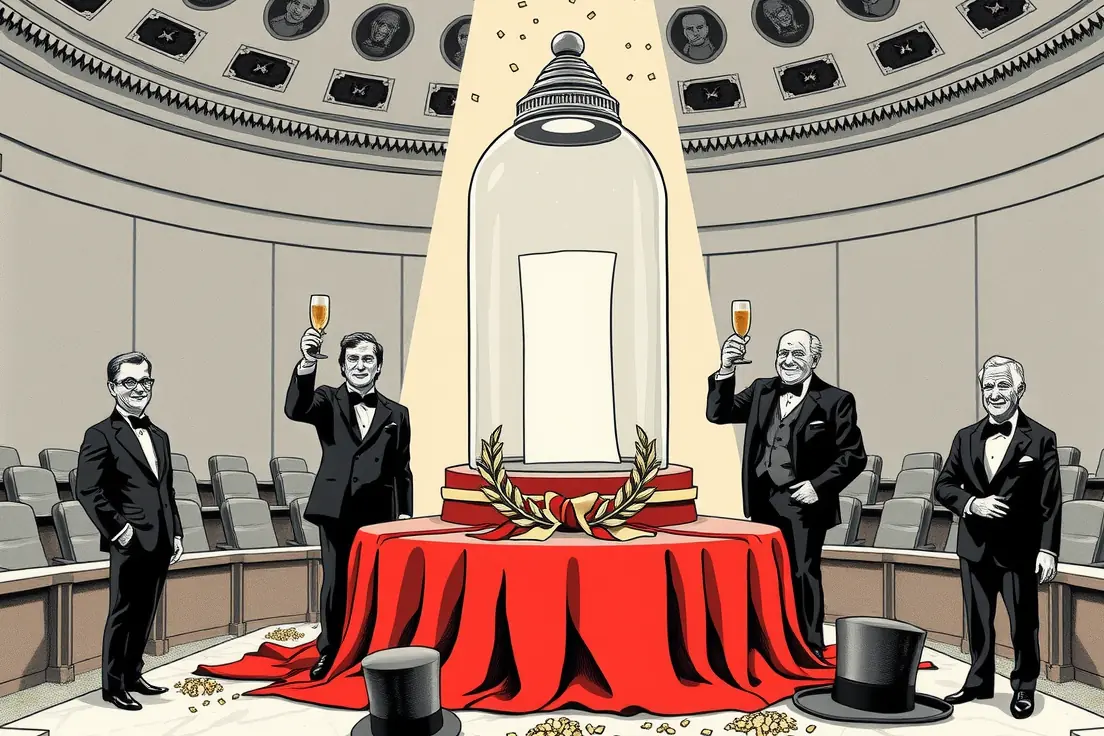
Whether the gavel is red or blue, almost nothing happens -- and the membership would like some credit for the effort.
There is a comforting bipartisanship to the modern Congress, and it is this: whether the gavel is red or blue, almost nothing happens.
A record low, measured properly
The 118th Congress (2023-2024) enacted just 274 public laws — the fewest of any Congress since the Civil War, per Axios. In calendar 2023 alone it managed 27 bills, the smallest annual haul since the Great Depression, PolitiFact confirmed. A nation founded on muskets, it seems, occasionally likes to legislate like it.
The 119th did not fix this so much as escalate it. From October 1 to November 12-13, 2025, the government sat closed for 43 days — the longest shutdown in U.S. history. It took 14 failed votes to end a crisis Congress manufactured itself, during which roughly 670,000 workers were furloughed, another 730,000 essential staff worked without pay, and about 42 million Americans on SNAP faced benefit cuts near 35% — all to inflict an estimated $7 billion in damage on the country the institution nominally represents.
The reward for enduring the longest shutdown in history? The exact same fight, rescheduled. Congress reopened the government having punted the healthcare dispute, then the House blocked a quick ACA subsidy extension 204-203 and left for the holidays, letting enhanced credits for roughly 22 million people expire December 31. Lawmakers then trooped back in January to pass a version of the thing they had just refused to pass — a maneuver Congress performs the way other workplaces perform payroll.
Shutdowns are a choice, not a failure
The ethics ledger, at least, hums along in perfect harmony. Republican George Santos was expelled 311-114, sentenced to 87 months, then commuted to time served and freed the same night. Democrat Bob Menendez drew 11 years over gold bars and stacked cash. Democrat Henry Cuellar was indicted, then pardoned. And a House Ethics report found “substantial evidence” that Republican Matt Gaetz paid for sex, including with a 17-year-old, while in office. The pattern is not partisan. It’s professional.
It is worth being precise about what “unproductive” means, because the raw bill count flatters them. A large share of what Congress does pass is ceremonial — post office renamings, commemorative coins, technical extensions of programmes that would otherwise lapse. Strip those out and the record of a modern Congress on the things it exists to do — budgets passed on time, oversight conducted, wars authorised — is thinner still. The government has not been funded through the ordinary appropriations process, on schedule, in decades. It is funded by crisis, in the small hours, under threat.
The shutdown mechanism deserves its own note, because it is the clearest illustration of the incentives. A shutdown is not a failure of the system in the sense of a bridge collapsing. It is a choice that has been made survivable for the people who choose it: members of Congress continue to be paid during a shutdown, by statute, while the federal workers they furlough do not. Whatever else that arrangement produces, it is not urgency.
And the pattern repeats because it works. Brinkmanship generates leverage, coverage, and fundraising email. Compromise generates a primary challenge. An institution that rewards the first and punishes the second will produce more of the first, and it has — reliably, through both parties’ majorities, for most of this century.
The strongest case for a quiet Congress, taken seriously
There is a real argument that bill counts are a terrible metric. A legislature that passes fewer, better-considered laws may be doing its job; a torrent of legislation is how you get thousand-page omnibuses nobody read. Divided government is supposed to produce less, and voters keep choosing divided government. On this view a slow Congress is the system working as designed.
The trouble is what fills the vacuum. Output did not fall because Congress deliberately restrained itself — it fell while the demand for governing stayed constant, and that demand moved to executive orders that reverse every four years and to courts that rule for a generation. Fewer laws did not mean less government. It meant less accountable government.
What would fix it, and who is stopping it
Most of the machinery is internal: restore regular order and committee markups, fund committee staff properly, and end the shutdown-as-leverage cycle with automatic continuing resolutions so that failing to agree costs the negotiators something instead of federal workers. Every one of these is a rules change or an ordinary bill. None requires an amendment. All of them reduce leadership’s discretion, which is precisely why leadership of both parties has declined to make them.
Voters noticed. Gallup clocked Congress at 10% approval and 86% disapproval in April 2026 — a whisker above the all-time 9% low recorded in November 2013, in the wake of that year’s shutdown. The salary for this performance: $174,000, unchanged since 2009. It is the one number Congress reliably protects.
The reward for enduring the longest shutdown in history was the exact same fight, rescheduled for January.