Congress Heroically Bans Insider Trading, Except The Part Where They Keep The Stocks
After 14 years of a law with a $200 fine and zero prosecutions, the House finally passed a "ban" that lets members hold everything they own, exempts the president, and comes pre-loaded with a poison pill.
232–198The July 22, 2026 House vote to ‘ban’ its own stock trading — 13 Democrats aboard
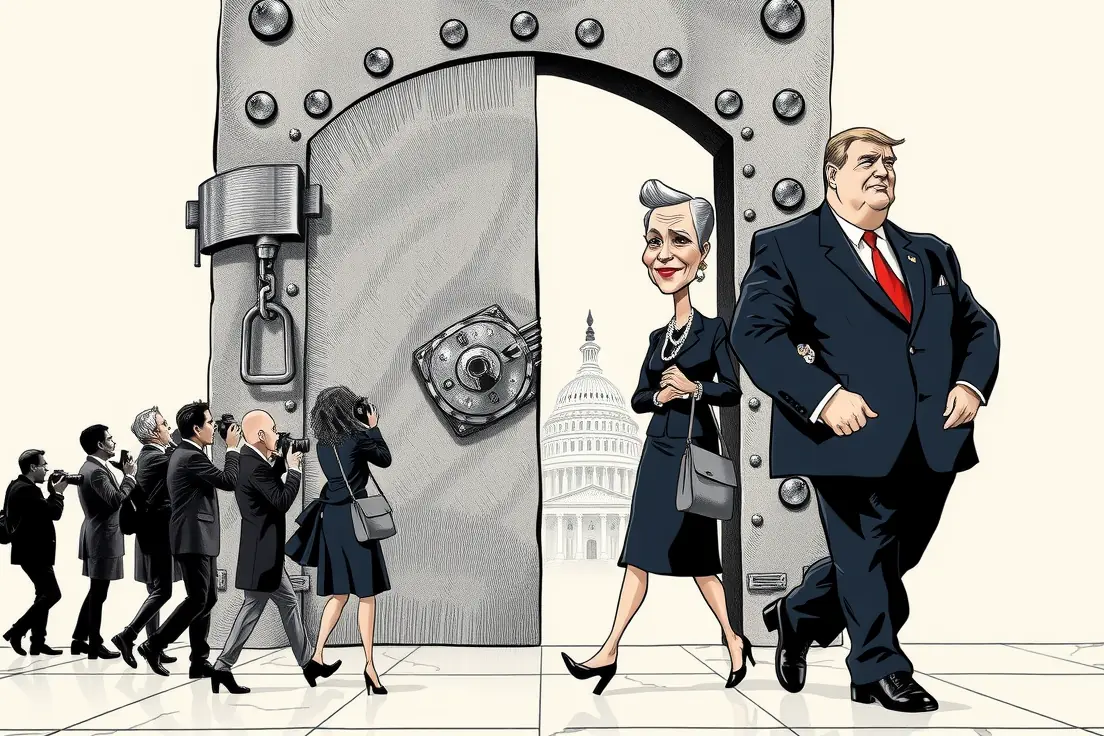
The ban is airtight — provided you overlook that members keep every share they already own and get a two-week window to sell.
For fourteen years, Congress has policed itself under the Stop Trading on Congressional Knowledge (STOCK) Act — a 2012 law so fearsome that the standard penalty for filing a trade late is a $200 late fee, which ethics committees routinely waive, and the number of sitting members criminally prosecuted under it since passage is, at last count, zero (GovGreed). Congress was so proud of this regime that in 2013 it quietly passed a one-page amendment (S.716) gutting the requirement for a searchable, sortable online disclosure database — by unanimous consent, with no recorded roll-call vote, so nobody could be blamed (OpenSecrets).
The law that was gutted two years after it passed
The results speak for themselves. In 2024, Democratic members’ portfolios rose an average of ~31% and Republicans’ ~26%, versus the S&P 500’s 24.9% (The Hill). Nancy Pelosi’s household — traded by her husband Paul, a man with an uncanny gift for Nvidia call options — returned roughly 70.9%, nearly triple the market and enough to make Warren Buffett feel like an amateur (Yahoo Finance). These, we are assured, are the fruits of pure instinct.
So on July 22, 2026, the People’s House finally acted, passing the Stop Insider Trading Act 232-198 (NOTUS). Sponsor Rep. Bryan Steil (R-WI) declared: “If you want to day trade, there’s a place for that. It’s called Wall Street” (Roll Call). The ban is airtight — provided you overlook that members may keep every share they already own and sell it with a mere 7-14 days’ public notice, generously giving citizens a two-week window to watch and do nothing. It also exempts the president and vice president, which is tidy, since Trump disclosed more than 3,600 buy and sell orders in the first quarter of this year alone (Fortune).
To ensure the bill expires with dignity, Republicans bolted on an unrelated federal voter-ID rider that Democrats, via Rep. Joe Morelle, called a “poison pill” (Roll Call). True bipartisanship at last: both parties get to kill reform while blaming the other.
What the 2026 bill actually does
Which raises the question the House vote was designed to avoid: what happens next door. The answer is almost certainly nothing. The Senate is unlikely to take the bill up at all — it would need sixty votes it does not have, and the voter-ID rider guarantees the Democrats required to get there will not supply them. There are roughly ten weeks of session left before the November 3 midterms. Do the arithmetic.
It is not as though the Senate lacks options. Sen. Josh Hawley’s considerably stronger ban cleared a Senate committee in July 2025 with Democratic votes — a genuinely bipartisan moment — and has sat untouched ever since, with no floor vote scheduled. Sens. Bill Cassidy and Pete Ricketts filed their own version. Others back the End Congressional Stock Trading Act. There is no shortage of bills. There is a shortage of roll calls.
That is the tell, and it is worth stating plainly: a reform with 86% public support, versions filed by members of both parties, and a committee already on record does not die of disagreement. It dies of scheduling.
The numbers, side by side
| Figure | |
|---|---|
| Public support for a ban | ~86% (87% R, 88% D) |
| STOCK Act criminal prosecutions of sitting members, 2012-2026 | 0 |
| Standard penalty for a late trade disclosure | $200, routinely waived |
| Senate session weeks left before the midterms | ~10 |
The strongest case against a ban, taken seriously
The honest objection is not “let us keep trading.” It is that a ban is a purity test that solves little: members would move assets into blind trusts or index funds they still benefit from, spouses and adult children create endless line-drawing problems, and a Congress of people wealthy enough not to care about their portfolios is not obviously more representative than one that trades. Enforcement would fall to the same ethics committees that currently waive the $200 fine.
All true, and none of it is an argument for the present arrangement — which combines full trading freedom with disclosure nobody enforces. “A ban is imperfect” is a reason to write a better ban, not a reason to keep zero prosecutions in fourteen years.
What would fix it, and who is stopping it
A ban needs an ordinary statute — no amendment, no states, no Supreme Court. It has passed one chamber. It dies in the other for a reason that has nothing to do with the merits: sixty votes and a poison-pill rider. The same arithmetic kills dark-money disclosure and every other reform with supermajority public support and no majority path.
None of this troubles the 86% of Americans — 87% of Republicans, 88% of Democrats — who have wanted a ban since 2023 (UMD). They can always just invest like their representatives: Wall Street now sells ETFs (NANC and KRUZ) that copy Congress’s disclosed trades (ETF.com). “Elected official” is now a documented investment strategy. Ask Sen. Richard Burr, who sold up to $1.7 million after early COVID briefings; the DOJ closed the case with no charges (CBS News). The $200 was presumably waived.
“Elected official” is now a documented investment strategy, sold to the public as an ETF.