A CONSTITUTION THAT CANNOT BE AMENDED GETS AMENDED ANYWAY — BY NINE PEOPLE
The last meaningful amendment passed in 1971. The document did not stop changing; it just stopped changing in public, by consent, in writing.
1971The last substantive amendment. More than 11,000 have been proposed; 27 ratified.
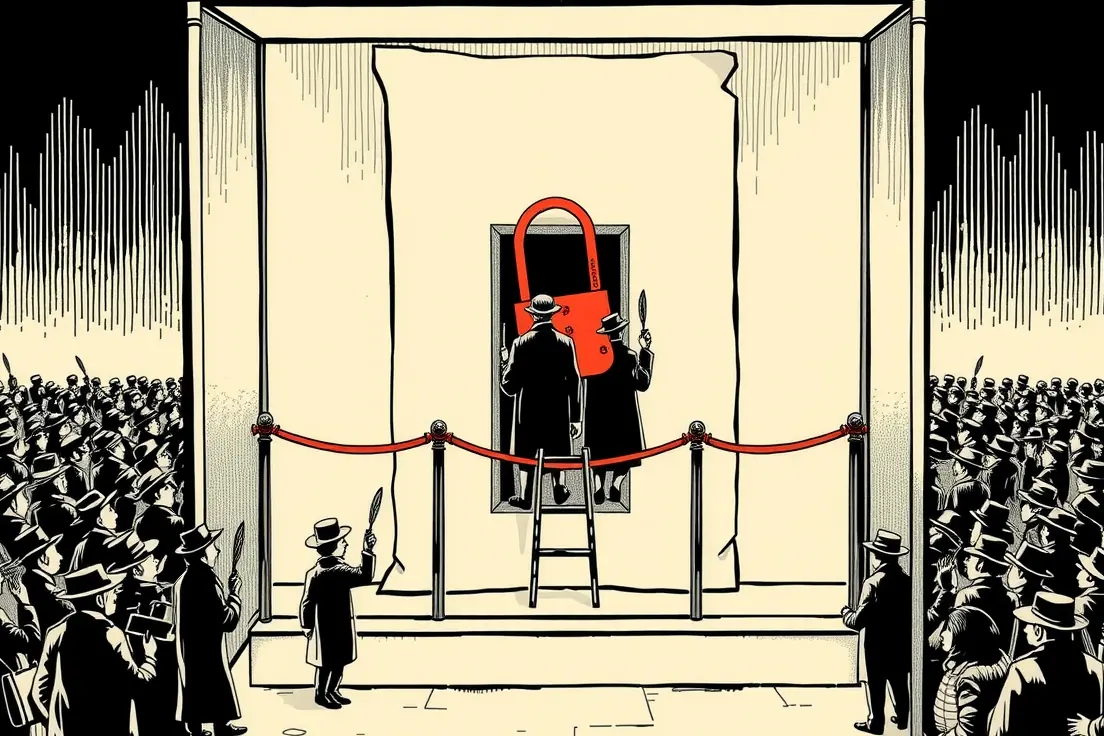
More than eleven thousand amendments proposed since 1789. Twenty-seven ratified. Two of those cancel each other out.
FACT: Article V requires two-thirds of both chambers of Congress, then ratification by three-quarters of the states — 38 of 50. Since 1789, more than 11,000 amendments have been proposed and 27 ratified. Ten of those twenty-seven were the Bill of Rights, adopted as a package at the founding.
The arithmetic
The last substantive amendment was the 26th, in 1971, lowering the voting age to eighteen. The 27th, ratified in 1992, was not a modern achievement — it was proposed in 1789 and sat unratified for 202 years until a university student noticed it was still technically pending and started a campaign.
So the practical position is this: in a country of 342 million, in a two-party system where the parties are within a few points of each other nationally, the thirteen smallest states — 4.4% of the population between them — can block any amendment. That is not a high bar. It is a sealed door.
Where the change went instead
More than eleven thousand amendments proposed since 1789. Twenty-seven ratified.
And here is the part that matters more than the arithmetic. The Constitution did not stop changing in 1971. Constitutional law in 2026 differs enormously from constitutional law in 1971 — on speech, on money in politics, on federal agency power, on presidential immunity, on which rights exist and which do not. All of that change happened through judicial interpretation, because when the formal channel is welded shut the pressure does not vanish, it finds the opening that is still available.
This is the honest explanation for something everyone finds distasteful and nobody quite accounts for: why Supreme Court confirmations became total war. They are not ugly because senators became less decorous. They are ugly because a lifetime appointment to a nine-member body is now, correctly understood, the most consequential constitutional-amendment mechanism the country has — and the only one that actually works. Fifty-one senators can do what two-thirds of Congress and thirty-eight states cannot.
OPINION: There is a genuine argument for a hard amendment process. A constitution that bends to every majority is not much of a constraint, and rights that can be repealed in one angry session are not rights. That case deserves respect.
But notice the trade actually being made. We did not choose stability over change; we chose judicial change over democratic change. Rigidity did not preserve the document — it transferred authorship of it from the country to the courts, where the public has no vote, no ratification, and no way to correct an error short of waiting for someone to die.
The strongest case for a hard amendment process, taken seriously
A constitution that bends to every majority is not a constraint, it is a suggestion. Rights repealable in one angry session are not rights, and the supermajority exists precisely so that a temporary national mood cannot strip protections from an unpopular minority. There is a further point worth conceding: several amendments that did clear the bar — Prohibition most obviously — were mistakes, and the difficulty of repeal is the only reason the country got to reconsider rather than live with them permanently. Making Article V easier means making bad amendments easier too, and whoever holds power when the lock loosens walks through the door first.
That is a serious argument and it is the strongest objection to everything proposed here.
What would fix it, and who is stopping it
The answer is not that Article V should be easy. It is that a threshold nothing has cleared in fifty-five years is not “hard,” it is closed — and closure has consequences its defenders rarely price in. The change did not stop; it relocated to nine unelected people with life tenure and to an executive branch governing by emergency, neither of which the public can ratify or reverse. Nobody is “stopping” Article V reform in the ordinary sense. It is the one problem on this site that cannot be fixed by the mechanism it has broken, which is why every other entry here ends at the same wall.
Every other reform on this site runs into this wall. Term limits, the Electoral College, campaign finance, an affirmative right to vote — each needs an amendment, and an amendment is functionally unavailable. That is not an accident of drafting. It is the load-bearing reason nothing changes, and it is the one problem that cannot be fixed by the mechanism it has broken.
The confirmation hearings are ugly because everyone understands that this is where the Constitution is actually rewritten now.