CONGRESS FIRED ITS OWN EXPERTS AND HIRED THE LOBBYISTS INSTEAD
The people who write the laws are twenty-six, underpaid, and gone in two years. The people explaining the laws to them are forty-five, well paid, and never leave.
Abolished 1995The Office of Technology Assessment — Congress's own independent science and technology advisers
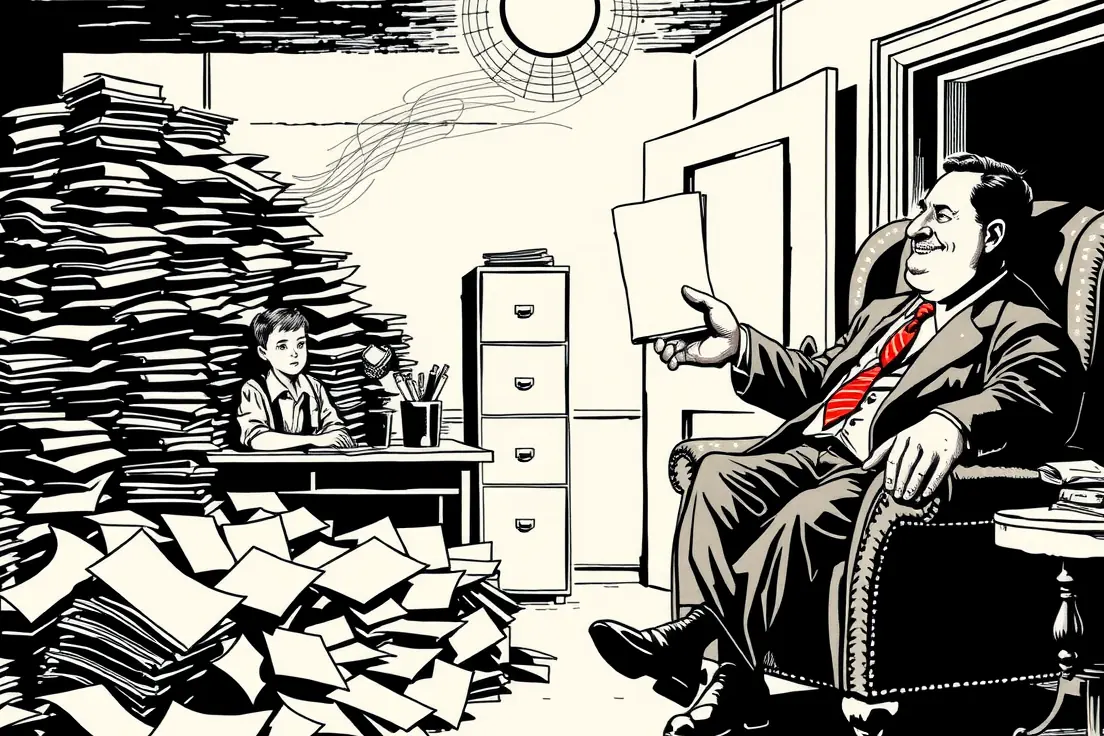
In 1995 Congress abolished its own independent technology assessment office. The expertise did not vanish — it moved to the people who could pay for it.
FACT: The bills that govern 335 million people are, in the ordinary case, drafted by congressional staff. Those staff are young, poorly paid relative to every alternative available to them, and they leave quickly. Committee staffing and legislative-branch capacity have been cut or flatlined for decades while the complexity of what Congress regulates — finance, pharmaceuticals, telecommunications, artificial intelligence — has gone the other way.
The one act that did the most damage
The clearest single act was in 1995, when Congress abolished the Office of Technology Assessment, its own nonpartisan in-house body of scientists and engineers, created in 1972 to give legislators independent technical analysis. The saving was trivial against the federal budget. The effect was permanent: the legislature deleted its own capacity to understand technical questions without asking someone with a stake in the answer.
That expertise did not evaporate. It relocated. It is now at trade associations, corporate government-affairs shops and law firms — where, as the revolving-door numbers show, a record 755 former congressional staffers registered as lobbyists in 2025 alone, up 45% in a year.
Picture the actual meeting
If the only person in the room who understands the bill works for the industry the bill regulates, the bill will be understandable to that industry.
Now picture the actual meeting. A 26-year-old legislative assistant, responsible for a portfolio spanning healthcare, tax and telecoms, paid a fraction of what their friends earn, is handed a 900-page bill. Across the table is a former staffer from that same committee, now employed by the affected industry, who has worked this one issue for fifteen years, who wrote analysis on it last month, and who has brought a helpful summary and some suggested language.
Nobody in that room is doing anything wrong. The lobbyist is not lying; they are frequently the most knowledgeable person present, and that is the problem. Information is not neutral — what gets emphasised, which trade-offs get named, which second-order effects go unmentioned — and the only party with the resources to shape it has a client.
OPINION: This is the least glamorous item on this site and possibly the most consequential, because it determines the content of everything else. Campaign finance decides who gets elected. Gerrymandering decides who can be. Staff capacity decides what they actually do once there — and a legislature that cannot analyse a bill without help will pass the bill it was handed.
The strongest case against just spending more, taken seriously
“More money for congressional staff” is an easy thing to sneer at, and the sneer has a point. Bigger staffs can mean more press aides and more constituent-service caseworkers rather than more policy expertise. Congress has periodically increased its budget without any visible improvement in the quality of legislation, and a body that cannot organise its own committee schedule will not be rescued by hiring.
The distinction that matters is between political staff and analytic capacity. Nobody needs another communications director. What was deleted in 1995 was a nonpartisan technical body whose entire output was analysis, and its absence is why the only person in the room who understands the bill now works for someone with a stake in it.
What would fix it, and who is stopping it
Restore an OTA-equivalent, fund committee staff, and pay legislative aides enough that a thirty-year-old can stay. The cost is a rounding error. Nobody is blocking it in the ordinary sense — no lobby opposes it publicly, no filibuster stands in its way. It simply has no constituency, while the industries that benefit from a legislature which cannot read its own bills have never had to spend a dollar defending the arrangement. It is the cheapest fix on this site and the least likely to happen, and those two facts are related.
The fix is embarrassingly cheap. Rebuilding OTA, funding committee staff properly, and paying legislative aides a salary that lets a 30-year-old with a mortgage stay would cost a rounding error on any single programme Congress votes on in a week. It has not happened because “more money for congressional staff” is the single least sellable line in American politics — which is exactly why the industries that benefit from Congress staying ignorant have never had to lift a finger to keep it that way.
If the only person in the room who understands the bill works for the industry the bill regulates, the bill will be understandable to that industry.