The House Finds a Bipartisan Fix for Presidential Lawbreaking: A Bigger Filing Cabinet
Impeached twice, acquitted twice, and now tabled on a schedule — how both parties turned the Constitution's emergency brake into a novelty rubber stamp.
2×Impeachments of Trump — acquitted both times; the only president impeached twice
Forty-seven Democrats voted ‘present’ — the parliamentary equivalent of leaving the group chat on read.
FACT: Donald Trump is the only president in American history impeached twice — in December 2019 for abuse of power and obstruction of Congress, and again in January 2021 for inciting the January 6 insurrection. The Senate declined to convict both times, including a 57–43 tally in 2021 that managed to be the most bipartisan presidential impeachment vote in U.S. history and ten votes short of meaning anything.
Tabled, on a schedule
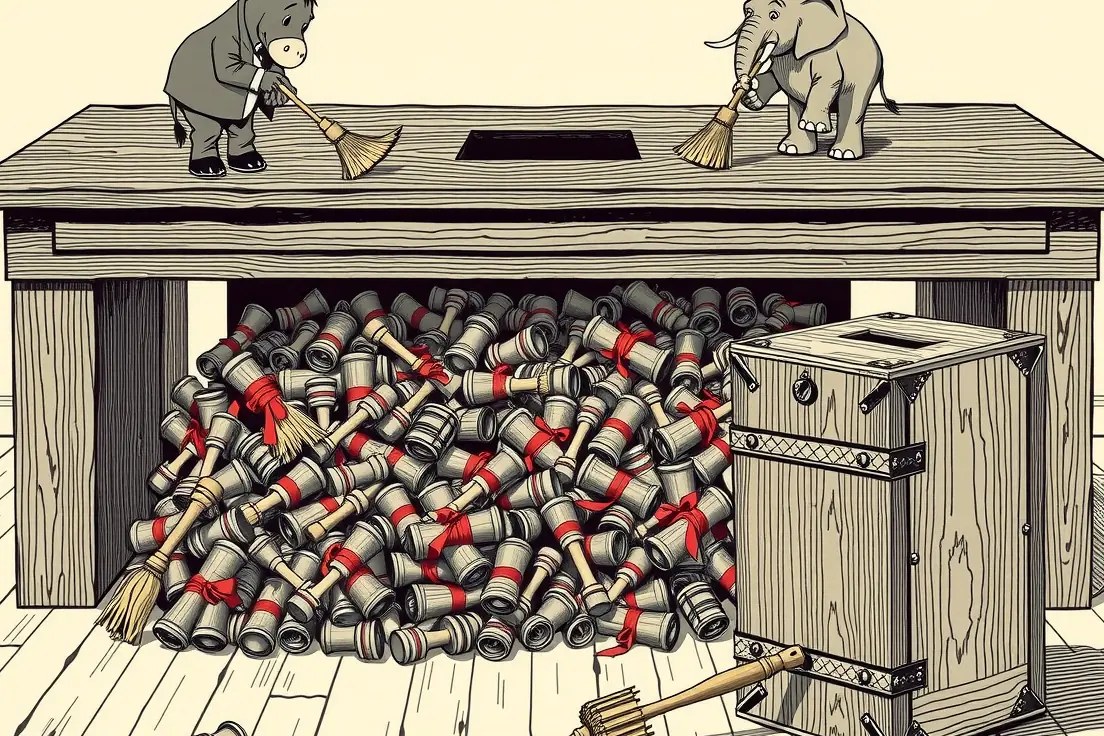
The 119th Congress has since treated impeachment less like a constitutional remedy and more like a magazine subscription nobody can cancel. Members filed H.Res. 353, 415, 537, 939, and 1155 (Congress.gov) — and every one that reached the floor was tabled with the brisk efficiency of a maître d’ clearing a plate. In June 2025 the House buried Rep. Al Green’s War Powers article over the unauthorized Iran strikes on a 344–79 vote, 128 Democrats pitching in (The Hill). In December 2025 it shelved his newest articles 237–140, with 47 Democrats heroically voting “present” — the parliamentary equivalent of leaving the group chat on read (The Hill).
Those articles, incidentally, answered the president posting on Truth Social that six Democratic lawmakers — several of them combat veterans — were guilty of “SEDITIOUS BEHAVIOR, punishable by DEATH!” (NBC News). Aides clarified he wasn’t threatening anyone — press secretary Karoline Leavitt said the president doesn’t actually want members of Congress executed, and Trump himself said “I’m not threatening them” — merely noting the maximum sentence, aspirationally.
Meanwhile the branches that don’t answer to the caucus did the flinching for it. On day one he pardoned or commuted roughly 1,500 January 6 defendants, including men convicted of seditious conspiracy and of assaulting police (Fortune). The Supreme Court struck down his emergency-powers tariffs 6–3 (Tax Foundation); federal judges declared his National Guard deployments to Los Angeles, D.C., Portland, and Chicago unlawful (SCOTUSblog); and Congress passed the Epstein Files Transparency Act 427–1 (NBC News) — after which the nation waited to learn how much would survive the redaction shredder.
The branches that did flinch
Step back from the particular president and the pattern is clearer, because it long predates him. Impeachment was designed as the Constitution’s emergency brake, and it has been slowly converted into a partisan loyalty test — by both parties, over decades. If conviction requires 67 senators, and senators vote with their party essentially always, then the brake can only ever engage when a president’s own party abandons him. That has happened approximately once, and he resigned before the vote.
Which means the honest description of impeachment today is not “a check on the executive” but “a poll of the Senate, conducted at great expense.” A tool that can only be used when it is not needed is not a safeguard. It is a ceremony.
That has consequences beyond any one presidency. Every president inherits the powers of the last one, and none of them give any back. Emergency authorities invoked for one purpose remain available for the next. Norms broken once are precedents thereafter. The question a voter should be asking is not only what this officeholder does with the powers of the office — it is what the next one, from either party, will find waiting for them.
The strongest case for a high bar, taken seriously
Sixty-seven votes is meant to be nearly unreachable, and for good reason. Impeachment removes an official the country elected; if a bare Senate majority could do it, every president facing an opposition Senate would govern under permanent threat, and impeachment would become a routine tool of partisan control rather than a remedy for grave misconduct. The Framers set the bar where they did precisely to prevent that, and a president removed on a party-line vote would be seen by half the country as the victim of a coup — which is its own crisis.
The problem is not the number. It is that a check which has never once operated in 250 years, across four attempts and both parties, is not a high bar. It is a decoration.
What would fix it, and who is stopping it
Lowering the threshold needs an amendment, which is unavailable. What is available is everything Congress already holds and declines to use: the power of the purse, subpoenas with real enforcement, ending the emergency declarations that supply much of the disputed authority, and repealing the 2001 AUMF. None needs a supermajority to propose — only the will to spend political capital checking a president of your own party, which is the thing that has actually gone extinct.
OPINION: Rushmore or prison, pick your poster. Just notice who kept flinching: a House of both parties that would rather vote “present” than vote. His approval sits at a record-low ~37% (Forbes). Impeachment can be tabled. War powers can be tabled. Even a death threat can be tabled. The one motion in Washington that can’t be? The one you file yourself, every two years, at the ballot box.
The most bipartisan impeachment vote in American history was still ten votes short of meaning anything.