Rule by Decree: The President Governed by Sharpie, and the Judges He Hired Kept Saying No
A midnight watchdog purge, a 227-year-old wartime law, tanks aimed at cardboard signs, and $200 billion in "emergency" tariffs — while Congress set an out-of-office reply.
17+Independent inspectors general fired in the January 2025 overnight purge
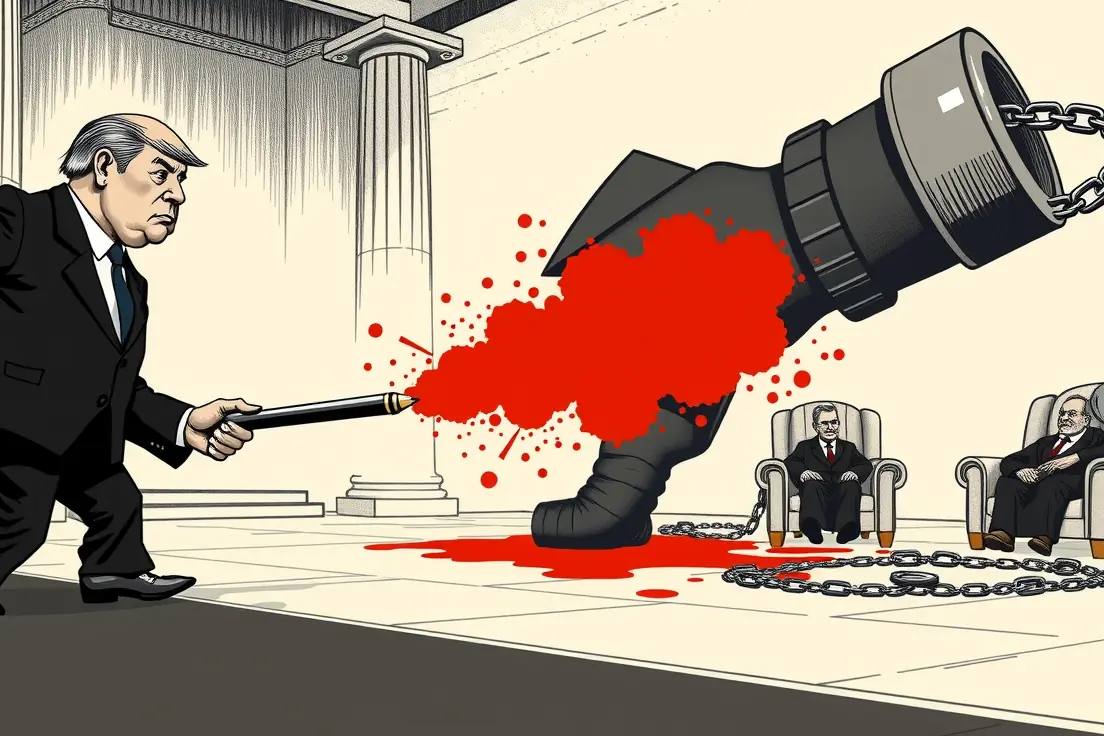
An injunction, it turns out, is a polite suggestion when you own jets.
FACT: In the second Trump term, the federal government increasingly ran on a single signature. On the night of Jan. 24, 2025, the president fired at least 17 independent inspectors general in an overnight purge, skipping the 30-day notice and written reasons the Inspector General Act requires; by late 2025, 21-plus watchdogs were gone and roughly 40% of IG offices sat vacant. On March 15, 2025 he dusted off the 1798 Alien Enemies Act to fly 238 Venezuelans to El Salvador’s CECOT mega-prison — 137 of them under the Act itself, the rest under ordinary immigration law. Guard troops were federalized against Los Angeles, Chicago, and Portland. And on Feb. 20, 2026 the Supreme Court struck down his “emergency” tariffs, 6-3. In nearly every case, the branch that said “no” was the judiciary — including judges he appointed.
The watchdogs went first
Consider the accountability infrastructure. Step one of running a clean government is apparently to remove every smoke detector, then act startled at the smell. When the fired watchdogs sued, a federal judge ruled it was obvious the president broke the law — and then declined to give them their jobs back, accountability arriving like a ghost that reads you the ticket and floats off. Note the value proposition being shredded: inspectors general had identified about $65 billion in potential savings against $3.9 billion in cost, a 17-to-1 return no rational cost-cutter would target.
On immigration, the administration achieved the impossible: it successfully offshored the Constitution. Deportees got roughly 24 hours’ notice with no instructions on how to contest removal, which the Supreme Court gently noted “does not pass muster.” Judge Boasberg ordered the flights halted; they took off anyway, earning a “probable cause” contempt finding for “willful disregard”. An injunction, it turns out, is a polite suggestion when you own jets. A Fifth Circuit panel found the gang was not a foreign “invasion” — a ruling the full court then vacated to rehear the case en banc, though the removals stayed blocked in the meantime — and by December a court was still ordering due process, nine months late, for people already swapped back home.
The courts did the work
On the home front, tanks rolled toward neighborhoods full of cardboard signs. A Trump-appointed judge in Portland ruled the “rebellion” was imaginary; another warned against a “profoundly un-American” standing army; the Supreme Court wouldn’t let the Chicago troops deploy. Then the tariffs: declare enough emergencies — trade, drugs, protesters — and “emergency” just means Tuesday. The Court unplugged the vending machine after it rang up more than $200 billion, noting a statute with “no reference to tariffs” is not a tariff machine. Refunds, naturally, are complicated.
What makes this period unusual is not that a president pushed at the edges of his authority — all of them do, and the office has expanded under every occupant since Roosevelt. It is which branch pushed back. The courts did the work. Congress, the branch actually designed for it, largely did not.
That inversion matters more than any single ruling. Judicial review is slow, narrow and reactive: it addresses the case in front of it, months or years late, and only if someone with standing sues. Congressional oversight is fast, broad and proactive — hearings, subpoenas, the power of the purse, and ultimately impeachment. Using the judiciary as the primary check on the executive is like using a coroner as your primary care physician. It works, technically, and the timing is terrible.
There is a reason Congress has abdicated, and it is not cowardice alone. A legislator who checks a president of their own party invites a primary challenge; one who checks a president of the other party is simply doing what is expected and earns nothing. The incentives point away from oversight in both directions. Institutional loyalty — the idea that a member of Congress is a member of Congress first — was the thing holding the design together, and it has quietly become optional.
Restoring it is not a legal problem. No court can order a legislator to care about the powers of their own branch. It is an electoral one.
The strongest case for a strong executive, taken seriously
The unitary-executive argument is not a fringe position and it deserves stating properly. Article II vests “the executive Power” in a president, singular. Elections are supposed to change policy, and a president who cannot direct the officials implementing that policy is a figurehead presiding over an unelected bureaucracy that outlasts every administration. When Congress delegates enormous discretion to agencies and then does not legislate for years, someone has to decide — and the person who at least faced a national electorate is a defensible choice.
Much of that is right. The distinction it elides is between direction and capacity: elections should change the direction of the state, not incinerate the inspectors general, statisticians and scientists who tell any administration what is actually happening.
What would fix it, and who is stopping it
Congress holds every tool: for-cause protection written into statute for oversight roles, emergency declarations that lapse without a vote, war authorisations that sunset, and appropriations riders it declines to attach. None requires an amendment or a court. The reason the judiciary ended up doing this work alone is not that Congress lacked authority. It is that a legislator checking a president of their own party invites a primary, and checking the other party’s president earns nothing — so the incentives point away from oversight in both directions.
OPINION: None of this required a coup — just a Congress content to auto-reply “out of office.” The 119th handed its oversight and spending powers to the executive and let the courts do a job it was built to do itself. That’s the real scandal: when your own umpires keep calling you out, the problem isn’t the umpires. But judges are the last line, not the first — and they never stand for reelection. Congress does. In November 2026, the ballot box is the one watchdog that can’t be fired at 11 p.m.
The administration achieved the impossible: it successfully offshored the Constitution.