Congress Notches Historic 10% Approval, Pledges to Return 98% of Itself to Office Anyway
A nation that can't stand Congress keeps re-hiring it — because the machine was built to make sure you would.
98%Incumbents re-elected in 2024 — while Congress polled 10% approval
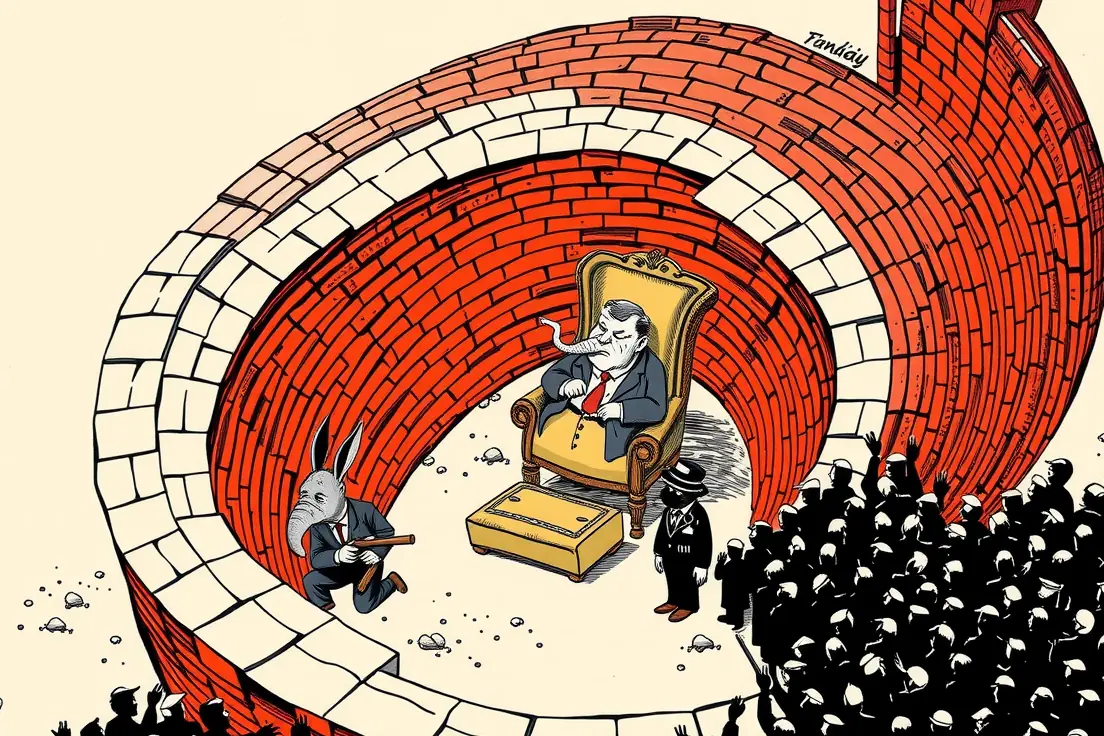
A country that loathes Congress 86-to-10 has decided, with touching consistency, that the problem is always the other 434.
There is a machine on Capitol Hill that runs on a beautiful contradiction. In April 2026, Gallup clocked congressional approval at 10%, with 86% disapproving — tying the worst rating the pollster has ever recorded (Gallup). Democrats gave their own Congress a 3% approval; Republican approval, which sat at 63% in March 2025, cratered along with everyone else’s. The needle is so close to the floor it’s basically doing push-ups.
What the 98% actually measures
And yet. In 2024, congressional incumbents were re-elected at a 98% clip — identical to 2022 (Ballotpedia). In 41 states, every single incumbent who sought another term won. A country that loathes Congress 86-to-10 has apparently decided, with touching consistency, that the problem is always the other 434.
This is not a fluke; it is engineering. Of 435 House districts in 2024, only 37 were decided by five points or fewer, and just 11 flipped (Brennan Center). The rest are pre-cooked. The genius of the safe seat is that the incumbent no longer needs your vote — merely your address, filed correctly by a consultant with a marker back in 2021.
Three moving parts
In an inspiring show of bipartisanship, both parties spent 2025 fighting over the sacred right to choose their voters before their voters can choose them. Texas redrew its map to manufacture five friendlier Republican seats; California answered with Proposition 50 in November 2025 to swing up to five toward Democrats (Greenberg Traurig). A federal court then struck down the Texas map as an illegal racial gerrymander, while California’s redraw stood (Governing) — leaving both camps in a heartfelt argument over which one gets to fire the electorate.
The people running this machine are in no rush to leave it. The 119th Congress is the third-oldest in history, average age 58.9, with 91-year-old Sen. Chuck Grassley anchoring the seniority parade (FiscalNote). Their $174,000 salary has been frozen since 2009 — a roughly 30% cut in real buying power (NOTUS) — a hardship Speaker Mike Johnson floated in 2025 with a genuinely inspired argument: pay members more, he suggested, and they’d be “less incentivized” to trade on the inside knowledge they pick up overseeing the very industries they invest in (NOTUS). The cure for the appearance of corruption, apparently, is a raise.
It helps to understand what the 98% is actually measuring, because it is not “voters like their representative.” It is closer to “voters are rarely offered an alternative.” The competitive ground has been shrinking for decades: of 435 House districts in 2024, only 37 were decided by five points or fewer. In the other 398, the general election was a formality and the real contest — if there was one — happened in a primary that most people skip.
The machine has three moving parts and none of them is a mystery. Districts are drawn by the people who benefit from them, in most states by the legislature itself, which is how you get seats that have not changed hands since the Nixon administration. Money follows incumbency rather than merit: sitting members start with a donor list, a staff paid by the taxpayer, and franked mail. And primaries are decided by a small, committed slice of the electorate, which rewards the safest possible incumbent and punishes almost nobody.
The result is a body that has effectively opted out of the feedback loop it was designed around. Members are not ignoring the 86% who disapprove; they are correctly reading a system in which that disapproval carries no consequence. Anger at Congress is diffuse and national. Elections are specific and local. Until those two facts meet in the same ballot box, the numbers will keep looking exactly like this.
Which is the one genuinely hopeful thing here: none of those three parts is a law of nature. Michigan voters took redistricting away from their legislature by ballot initiative. Primaries are the cheapest election in America to influence, and the least attended. The 98% is not a verdict on the possible. It is a description of what has been tried.
The strongest case for incumbency, taken seriously
Experience is not nothing. Legislating is a skill; committee seniority builds genuine expertise; a member who has run the same subcommittee for a decade knows where the bodies are buried in a way a newcomer cannot. High re-election rates might simply mean constituents are satisfied with their own representative even while despising the institution — the classic finding that everyone hates Congress and likes their congressman.
That defence would carry more weight if the seats were contested. Satisfaction expressed in a district drawn to be uncontestable, decided in a primary most voters skip, is not a measurement of anything. You cannot infer consent from an election that offered no alternative.
What would fix it, and who is stopping it
Three fixes, none requiring an amendment: independent redistricting to make general elections competitive again (which states are actively dismantling), expanding the House so districts shrink and campaigns cost less, and open or ranked primaries so the decisive round is not a closed contest. Each is available at state level or by ordinary statute. Each reduces the safety of currently safe seats, which is why the people holding them have shown no interest.
So the machine hums on: approval in the basement, re-election in the stratosphere, the lever marked SOMEONE ELSE sealed behind glass. In 2026, voters get one wild idea. Break the glass.
The safe seat’s genius: the incumbent no longer needs your vote — just your address, filed correctly by a consultant with a marker back in 2021.