THE JOB WAS NEVER THE JOB: CONGRESS AS A PAID INTERNSHIP FOR K STREET
In the 1970s fewer than one in ten members left Congress for lobbying. It is now roughly two in three — and the record is being broken by their staff.
10% → 66%Share of departing members of Congress who become lobbyists, 1970s versus recent years
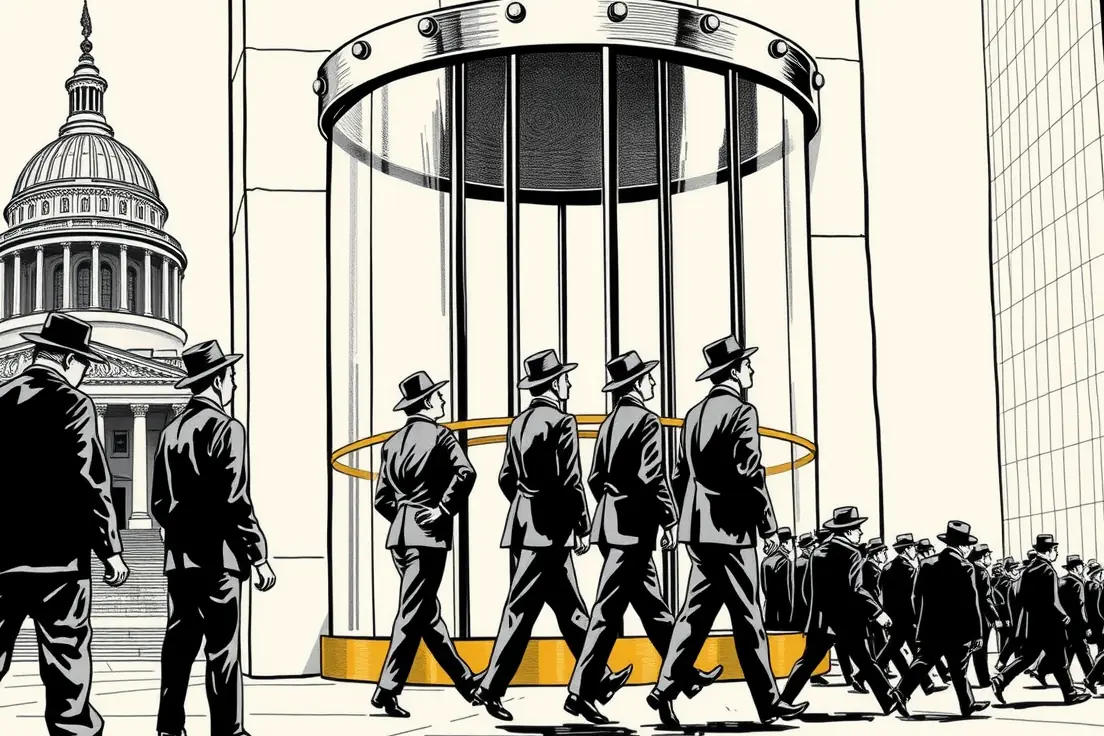
Fewer than one in ten in the 1970s. Roughly two in three now. Nothing about the job changed — the exit did.
FACT: In the 1970s, fewer than 10% of departing members of Congress became lobbyists. By 2019 it was approaching two thirds. The job did not change. The salary did not change much. What changed is what the job became a qualification for.
The 2025 figures, and the split that matters
The 2025 figures are not a blip, they are the machine at cruising speed. LegiStorm counted 866 people moving from Congress to K Street in a single year: 440 Republicans (50.8%) and 384 Democrats (44.3%). Look at those two numbers next to each other, because they are the entire argument of this website in one line. The split is almost exactly proportional to the chambers themselves. Whatever this is, it is not a faction, a wing, or one party’s rot. It is a career path, and it is the normal one.
Their staff are moving faster. As of November 2025, 755 former congressional employees had registered as lobbyists — a 45% increase over 2024, and a record. These are the people who actually draft the text of legislation. The institutional memory of the United States Congress is being transferred, annually, to the entities it regulates.
What the cooling-off period actually restrains
440 Republicans and 384 Democrats walked the same corridor in the same year. This is not a faction. It is a profession.
The formal safeguard is a “cooling-off” period: one year for departing House members, two for senators, before they may lobby their former colleagues directly. Consider how little that restrains. It does not stop a former member joining a lobbying firm the week they leave — only from personally making the ask. It does not touch strategy, introductions, or the client-facing value of a name. And it expires precisely when the relationships are still warm and the votes they cast are still recent.
There is a bill. There is always a bill. The Close the Revolving Door Act of 2025 would impose a lifetime lobbying ban on former members, a six-year cooling-off period for senior staff, and a public lobbying database. It has not received a vote. It has never received a vote in any of the Congresses in which versions of it have been filed.
OPINION: Nothing described above is illegal, and that is the point this site keeps arriving at from different directions. No bribe is required. Nobody has to be told anything. A member of Congress who spends a decade voting on an industry’s business, knowing that industry is the most likely buyer of their next decade, does not need to be corrupted — they need only to be rational, and to notice which votes make a person employable.
The strongest case against a lifetime ban, taken seriously
A permanent bar on lobbying is a permanent bar on employment, imposed on private citizens for having held public office. It would push talented people away from public service precisely when Congress most needs them, and it would fall hardest on members without personal wealth — the ones for whom a post-Congress income actually matters. There is also a First Amendment dimension: lobbying is petitioning the government, which is an enumerated right, and a lifetime prohibition on exercising it is not obviously constitutional.
The proportionate answer is not a lifetime ban but a cooling-off period long enough to matter — six years rather than one or two, so relationships cool and the votes cast are stale — plus disclosure that captures strategic advice, not merely the direct ask.
What would fix it, and who is stopping it
The Close the Revolving Door Act has been filed in Congress after Congress and never received a vote in any of them. It requires no amendment. You are asking 535 people to vote, on the record, to devalue the most valuable asset most of them will ever hold — which is not the seat, but what the seat is worth afterwards.
The honest framing is not that lobbyists have captured Congress. It is that Congress has become the training programme. And the reason the fix never gets a vote is not mysterious: you are asking 535 people to vote, on the record, to devalue the single most valuable asset they will ever own — which is not their seat, but the thing their seat lets them sell afterwards.
440 Republicans and 384 Democrats walked the same corridor in the same year. This is not a faction. It is a profession.