ETHICS: OPTIONAL — THE COURT THAT JUDGES EVERYONE BUT ITSELF
Nine unelected referees finally wrote an ethics code, then forgot to hire anyone allowed to enforce it.
42%SCOTUS job approval, near record low (Gallup, Sept 2025)
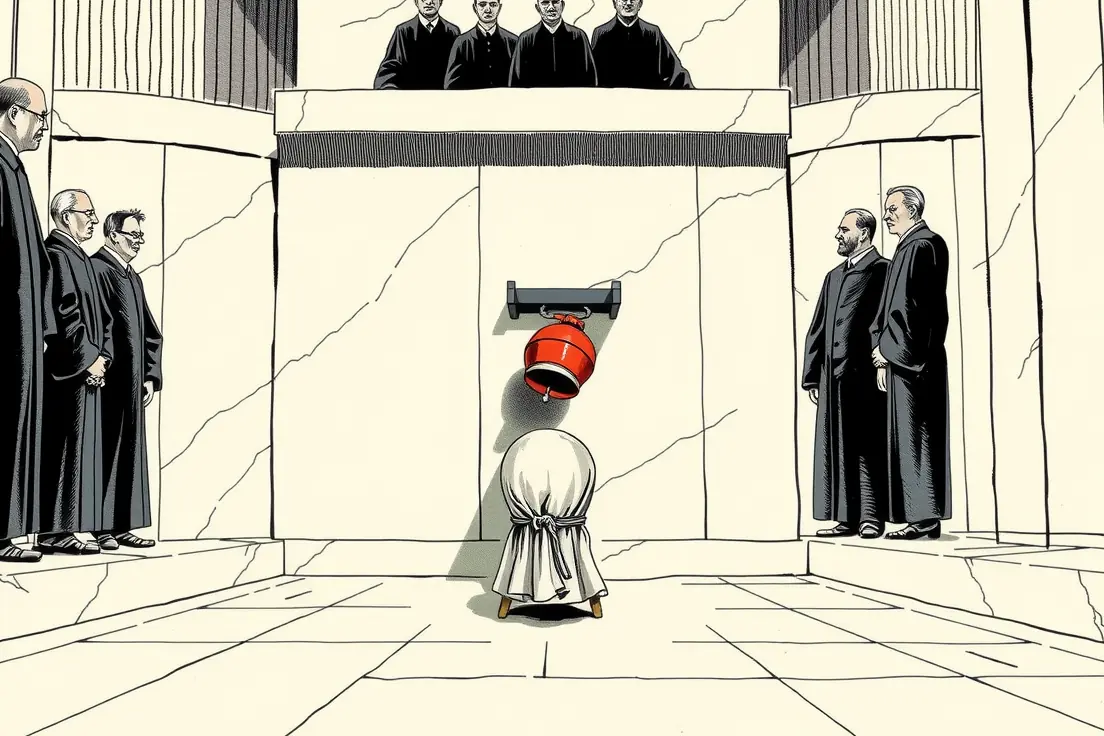
A speed limit with no highway patrol, a fire alarm wired to nothing.
FACT: There is a fourth branch of American government, and it wears a robe. Nine of them, actually — appointed for life, answerable to no voter, and, as of November 13, 2023, governed by the first written Code of Conduct in the Court’s history. Historic! Read past the preamble, though, and the milestone turns hollow. The code, in its own words, “is not designed or intended as a basis for civil liability or criminal prosecution,” and it never names who — if anyone — decides when a justice has crossed a line. It is a speed limit with no highway patrol. A fire alarm wired to nothing.
Where the code came from
The code did not descend from the heavens. It fell out of ProPublica. Beginning in 2023, reporters documented that Justice Clarence Thomas had spent two decades accepting luxury travel from Dallas billionaire Harlan Crow and a rotating cast of other ultrawealthy men — none of it disclosed. By one tally the hospitality ran to at least 38 destination vacations, 26 private-jet flights, eight helicopter rides, and a standing membership at an exclusive golf club. One nine-day 2019 island-hopping trip through Indonesia, by private jet and 162-foot superyacht, would have cost more than half a million dollars had he chartered it himself.
Crow’s generosity was not limited to travel. He also covered private-school tuition for a Thomas relative and paid the justice money in an undisclosed 2014 real-estate deal. Seven ethics-law experts told ProPublica that Thomas appeared to have violated federal law by omitting the trips: gifts above roughly $415 generally have to be reported, and the disclosure rules are not ambiguous. Thomas has since amended some filings and acknowledged he should have disclosed the 2019 Bali trip, explaining that earlier omissions were “inadvertent.”
He is not the only one. Justice Samuel Alito took a 2008 Alaska fishing trip on a hedge-fund billionaire’s private jet, never reported it, and did not recuse when that same donor’s business later arrived at the Court.
The double standard, stated plainly
The justices wrote themselves a rulebook. Then they quietly declined to appoint anyone to read it.
Here is the part that ought to unite left and right, if we let it: no branch should grade its own homework. Every other federal judge in the country is bound by the Judicial Conduct and Disability Act, with a real complaint process and real investigators. The nine most powerful judges in America are exempt. They receive the complaint, weigh it, clear themselves, and hand down the verdict from the same bench — and there is no appeal, because they are who you would appeal to.
Congress has noticed, and Congress has done nothing. The Supreme Court Ethics, Recusal, and Transparency Act — which would impose a binding code, create an actual investigative mechanism, tighten gift and travel disclosure, and stop justices from ruling on their own conflicts — was reintroduced on May 20, 2025 by Sen. Sheldon Whitehouse and Rep. Hank Johnson. It sits, as it has sat through multiple Congresses, as a bill — advanced out of committee on a party-line vote and never enacted. Judicial ethics, it turns out, is a bipartisan concern right up until the roll is called.
The public has drawn its own conclusions. Gallup’s September 2025 survey pegged Supreme Court approval at 42%, camped near its all-time low, with a record 43% saying the Court is “too conservative.” Pew clocked favorable views down 22 points since 2020 — from 70% to roughly half the country. An institution whose only currency is legitimacy has spent a quarter of it in five years.
The strongest case for judicial self-governance, taken seriously
Judicial independence is not a courtesy; it is the point. A court that can be investigated by Congress is a court Congress can pressure, and an ethics complaint is a cheap weapon against a judge whose rulings someone dislikes. If a hostile legislature can open proceedings against a justice, the threat alone shapes decisions — which is precisely what life tenure exists to prevent. There is also a real separation-of-powers question about whether Congress may regulate the internal conduct of a co-equal branch at all.
The answer is that every other federal judge already lives under exactly such a regime, and the republic has survived it. The question is not whether judges should be independent. It is why the nine most powerful ones are the only ones who investigate themselves.
What would fix it, and who is stopping it
The SCERT Act — a binding code, an investigative mechanism, real gift and travel disclosure, and an end to justices ruling on their own recusals — has been filed in Congress after Congress. It has cleared committee on a party-line vote and never reached a floor. It needs no amendment. It needs sixty votes, and a Senate willing to spend them on the branch that decides what the Constitution now says.
OPINION: The Court gets the last word on everyone else’s ethics — on which gifts a mayor may accept, which conflicts a judge must declare, which disclosures a president may skip. On its own conduct it drafted a rule, left the enforcement line blank, and dared anyone to fill it in. You cannot vote a justice out; that is the design, and mostly it is a good one. But you can vote for the ninety-nine senators and one president who choose them, confirm them, and could — at any point in the last three years — have made the rulebook mean something.
They can strike down any law they dislike. They just can’t seem to find the paperwork.